On this page
Passenger & cargo aircraft requirements for
Passenger aircraft carry paying passengers, with cargo in the lower hold. Cargo aircraft (freighters) carry freight only, with no passengers on board.
Choosing which aircraft type a shipment of UN 1263 (Paint) can use is one of the first important decisions in the process.
Passenger aircraft offer more routes, more frequent flights, and generally lower costs, but they allow smaller quantities per package.
Cargo-only aircraft allow larger quantities, but they have fewer flights, longer transit times, and higher costs.
Some dangerous goods are restricted to either passenger aircraft or cargo-only aircraft, but UN 1263 (Paint) is not. It can be transported on both types of aircraft:
Passenger aircraft 💺 — PERMITTED
Cargo aircraft ✈️ — PERMITTED
“Permitted” does not mean the substance can be carried by air without restriction. It is still a dangerous good and must comply with strict packing, packaging, marking, labelling, documentation and quantity rules imposed by IATA/ICAO, as well as by individual countries and airline operators.
excepted & limited quantity provisions for
Exemptions allow you to ship smaller quantities under simplified rules, with reduced packaging, marking, and documentation compared to a full shipment. They don’t remove the hazard classification—only the amount of compliance work required.
Limited quantity
Max net quantity per package — 1 L
Packing instruction — Y341
Excepted quantity
Max net quantity per package — 500 mL
Check carefully the inner packaging strict quantity limits.
permitted packaging for
PI 353 and PI 364 permit multiple outer packaging types for UN 1263 (Paint), provided each is tested and certified to the following requirements:
UN Packing Group II (performance standards)
Packaging types and packaging systems (single, combination, composite packagings) varies depending of the packaging instructions and special provisions.
But, here are examples of outer packaging to carry UN 1263 (Paint):
Drum
Steel — 1A1, 1A2
Aluminium — 1B1, 1B2
Plywood — 1D
Fibre — 1G
Plastic — 1H1, 1H2
Other metal — 1N1, 1N2
Jerricans
Steel — 3A1, 3A2
Aluminium — 3B1, 3B2
Plastic — 3H1, 3H2
Boxes
Steel — 4A
Aluminium — 4B
Wood — 4C1, 4C2
Plywood — 4D
Reconstituted wood — 4F
Fibreboard — 4G
Plastic — 4H1, 4H2
Other metal — 4N
marks & labels for
Labels and marks communicate hazards and shipping methods to ground handlers, airline crew, and emergency responders at a glance—without anyone needing to open the package or check the paperwork first.
Marking
Packaging specification (packaging manufacturer)
Consignor
Consignee
UN/ID number
Proper shipping name
Max net quantity per package
Limited quantity (if applicable)
Excepted quantity (if applicable)
Labelling
Class 3 — Flammable liquid
Cargo Aircraft Only (if applicable)
Package orientation

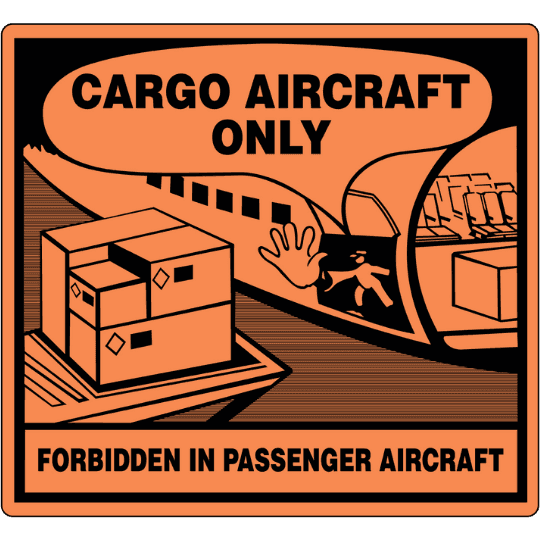


Other marking and labelling requirements must be applied for overpack, environmentally hazardous substances, lithium ion batteries, magnetized materials.
special provisions for
The ICAO/IATA Dangerous Goods Regulations include several hundred special provisions —additional requirements assigned to specific UN numbers, beyond the standard packing instructions.
When a special provision applies, it overrides the packing instruction and quantity rules shown above.
It may add packaging conditions, restrict a shipping method that would otherwise be allowed, require extra documentation, or impose limits not mentioned in the general rules.
The packing instruction alone is never the full picture. It must cross-reference with the special provisions that apply to a specific UN/ID number.
UN 1263 (Paint) is subject to 3 special provisions.
State variations for
Some countries impose dangerous goods requirements that are stricter than the ICAO/IATA regulations for goods entering, leaving, or transiting their territory.
When country restrictions apply to a specific UN/ID number, it overrides the standard rules shown above — a country may limit quantities, require additional approval, or prohibit a shipping method that ICAO/IATA would otherwise permit.
UN 1263 (Paint) is subject to restrictions by 4 countries.
operator variations for
Individual airline operators may impose dangerous goods requirements that are stricter than ICAO/IATA regulations.
An airline operator may refuse carriage entirely, reduce the allowable quantity below the standard limits, or impose additional handling requirements.
Where an airline operator restriction applies, it overrides the general rules shown above for that specific carrier.
UN 1263 (Paint) is subject to restrictions by 35 airlines.
Why is dangerous on an aircraft?
UN 1263 (Paint) has a low flash point (between 23°C and 60°C) and generates flammable vapors. In an aircraft's pressurized, oxygen-enriched environment, vapor accumulation in cargo holds increases explosion and fire risk, especially near ignition sources like electrical faults or static discharge.
Aircraft cargo hold fire suppression systems are designed for solid-fuel fires, not flammable liquid pool fires. A leaking or ruptured container could feed a fire the system can't fully extinguish, posing a critical risk during flight when diversion isn't always immediate.